Educational summary of a CPD talk by Dr Beng Eu (GP, practice owner, researcher; Senior Fellow, Department of General Practice and Primary Care, University of Melbourne; principal investigator of the PUSH! Audit), who speaks on performance- and image-enhancing drugs (PIEDs) and HIV medicine. This note is for Gold Coast GP harm-reduction practice — not a guide to prescribe anabolic–androgenic steroids (AAS). Check current guidelines, local law, and your own clinical judgment before you change care.
Purpose of this note
Ask soft, monitor measurable harms, treat what you can, and keep the door open. PUSH! shows that GP contact changes behaviour. Do not invent PBS items for non-prescribed AAS, and do not prescribe AAS for non-medical enhancement.
Terminology
- Anabolic–androgenic steroids (AAS) — synthetic androgens used for muscle, strength or appearance when non-prescribed.
- Non-prescribed vs prescribed testosterone — community AAS use is usually unmonitored and stacked; prescribed testosterone replacement sits in a different risk and governance frame. Do not collapse the two in the history or the notes.
- PIEDs — umbrella for performance- and image-enhancing drugs. AAS have historically been the majority; peptides and related agents are rising in clinic talk.
- “Post-cycle therapy” (PCT) — commonly discussed online; often without strong evidence. Treat claims as patient-reported plans, not protocols you endorse.
Why GPs care
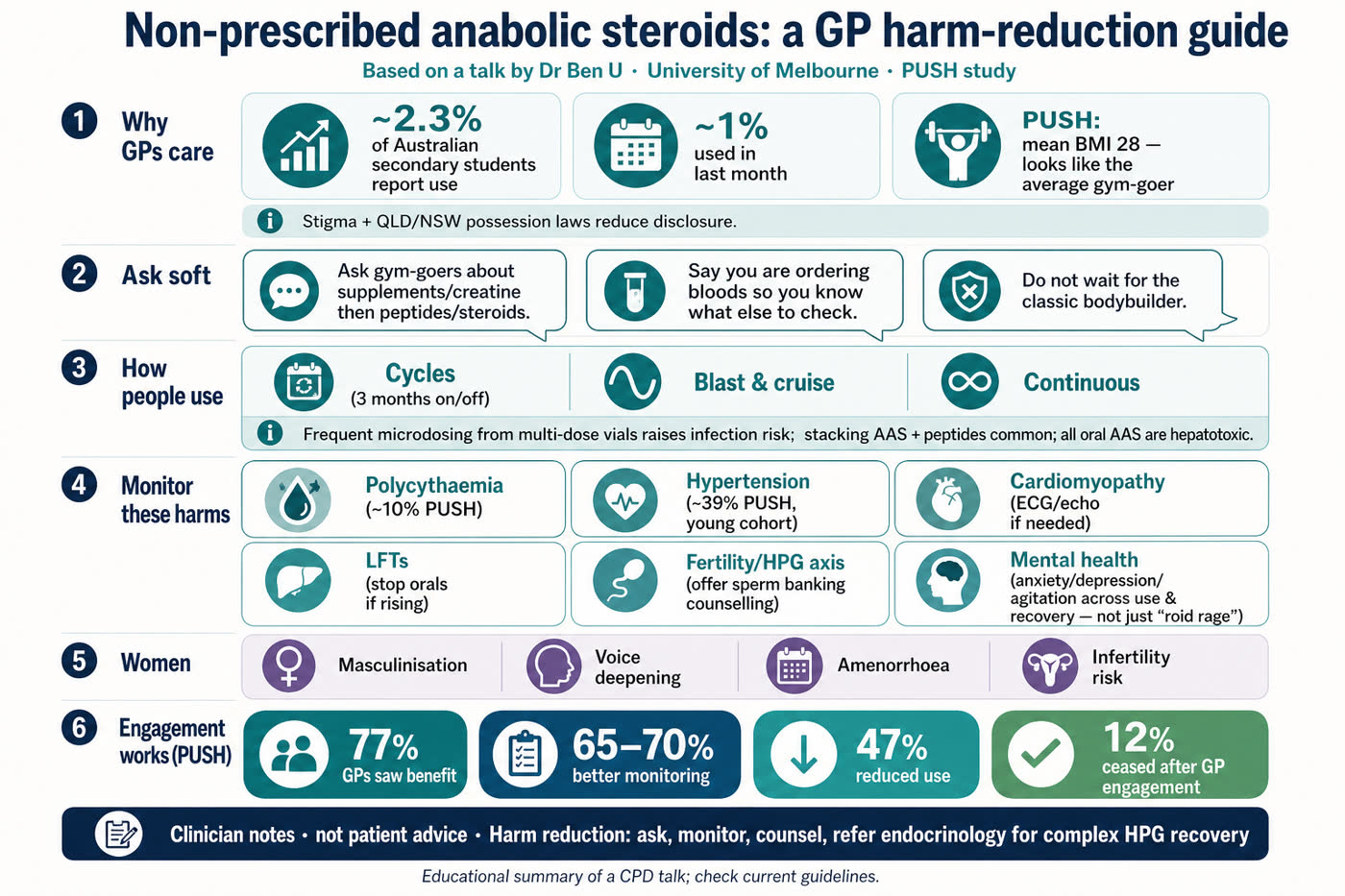
Prevalence is not rare in adolescents. The PUSH! AJGP paper summarises Australian Secondary Schools Alcohol and Drugs (ASSAD) survey data as about 2–3% among secondary school students. In the CPD talk, figures of roughly 2.3% lifetime and ~1% last month among 12–17-year-olds were cited — treat the exact decimals as talk-cited unless you open the ASSAD tables yourself. Stigma plus criminalisation of possession in jurisdictions including Queensland and New South Wales reduce disclosure. In PUSH cohorts, mean BMI was around 28 — do not wait for a bodybuilder phenotype before you ask.
Disclosure barrier
People who use non-prescribed PIEDs often fear judgment or legal consequences. Non-judgemental curiosity is the clinical skill; mandatory reporting of PIED use itself is not the Australian GP default described in the PUSH literature — still follow your local mandatory-reporting rules for children and other protected situations.
Ask soft
Open with supplements, then creatine, then peptides or steroids. Link the question to bloods you already need (“before we interpret these hormones / LFTs / FBC…”). Normalise that many people in training gyms use something, and that you are there to reduce harm, not to police.
Use patterns you will hear
- Intramuscular injection (sometimes subcutaneous) from multi-dose vials.
- Frequent microdosing as well as traditional weekly or biweekly injections.
- Stacking several agents; cycles vs blast/cruise vs continuous use.
- All oral AAS are hepatotoxic — raised LFTs are a concrete lever to stop orals.
Harms to manage in general practice
| Domain | GP actions |
|---|---|
| Polycythaemia | Watch haemoglobin / haematocrit; counsel hydration, review dose intensity with the patient, escalate if symptomatic or markedly raised. |
| Hypertension | Common. Talk cited ~39%; PUSH health-effects work reports higher hypertension risk than with prescribed testosterone — measure BP every visit and treat on usual GP grounds. |
| Cardiomyopathy / CV risk | BP, ECG when indicated, low threshold for echo or cardiology if symptoms, murmur, or sustained hypertension. |
| Liver | LFTs — objective reason to stop oral AAS; investigate other causes as usual. |
| HPG axis / fertility | Expect suppression on AAS. Offer sperm-banking counselling before prolonged use if fertility matters. Complex recovery — shared care with endocrinology. |
| Mental health | Mood and behaviour shift across on-cycle, PCT and off-cycle phases — not only “roid rage”. Screen and treat anxiety/depression; PUSH found recorded anxiety/depression associated with less behaviour change. |
| Women | Masculinisation, voice change, amenorrhoea, infertility risk — early engagement and specialist input where needed. |
Engagement works — published PUSH! numbers
From the AJGP April 2023 PUSH! Audit (Eu et al.; use these published figures, not rounded talk estimates):
- 144 audits collected in the paper’s framing; behaviour/outcome change in 81.6% of analysed engagements.
- Among those with change: better monitoring 71.3%; treatment of adverse effects 64.4%; modified use 44.4%; stopped use 12.2%.
Ask, monitor, treat harms, and renegotiate intensity. That is the GP job.
Gold Coast practice tips
Document the conversation as harm reduction and medical monitoring. Offer needle-and-syringe program advice where relevant. Do not supply scripts for non-medical AAS or for unproven PCT stacks. Refer endocrinology for difficult hypogonadism recovery, and cardiology when the heart story is not straightforward.
Resources
- Sydney North Health Network — Steroid Harm Minimisation GP guide.
- AJGP management article on patients using AAS / PIEDs (including peptides context).
- AJGP PUSH! harm-reduction research paper (April 2023).
This is an educational summary of a CPD talk plus published PUSH literature. It is not Therapeutic Guidelines, not a prescribing protocol, and not legal advice.
Sources
- Eu B, Dawe J, Dunn M, et al. Impact of harm reduction practice on the use of non-prescribed performance and image-enhancing drugs: The PUSH! Audit. AJGP 2023;52(4). Published stats: 144 audits; 81.6% positive change; better monitoring 71.3%; treatment of adverse effects 64.4%; modified use 44.4%; stopped use 12.2%.
- DOI: 10.31128/AJGP-04-22-6402 (PUSH! Audit).
- PUSH health-effects / related Drug and Alcohol Review paper (DOI 10.1111/dar.13899) — hypertension and other health effects context vs prescribed testosterone.
- Sydney North Health Network — Steroid Harm Minimisation (GP guide to harm minimisation for non-prescribed AAS and other PIEDs).
- RACGP AJGP attachment — Management of patients using anabolic androgenic steroids / PIEDs (management and peptides context).
- Positive Choices PIED factsheet summarising ASSAD 2022–2023: about 2% of 12–17-year-olds used performance or image-enhancing drugs in the past year (Scully et al., Cancer Council Victoria).
- Australian Government — Trends in substance use among Australian secondary school students 1996–2017 (ASSAD). AJGP PUSH cites ASSAD as ~2–3% among secondary students; talk-cited ~2.3% lifetime / ~1% last month — verify against the ASSAD edition you use.
- Educational summary of a CPD talk by Dr Beng Eu (University of Melbourne / PUSH! Audit PI). Check current guidelines before changing practice.